
I Almost Got Hit by a Car While Running With Earbuds In. These Headphones Fixed the Problem I Didn’t Know I Had.


THE “TL;DR”
- Open-ear bone conduction - hear music and your surroundings at the same time
- Built-in 32GB MP3 storage - leave your phone at home
- IPX8 waterproof for rain, sweat, and swimming
- Ultra-lightweight at just 30 grams
- 5+ hours of continuous playtime
- Bluetooth 6.0 for fast, stable connection
The Honk That Changed How I Listen to Music

I’ve been a morning runner for six years.
Same route. Same playlist. Same pair of wireless earbuds shoved in my ears to drown out the world.
Until one Tuesday in October. I was two miles into my run, crossing a side street I’ve crossed a hundred times. Music up. Head down.
Then a car horn blared so close I felt it in my chest.
I jumped back. The car missed me by what felt like inches. The driver yelled something I couldn’t hear - because my earbuds were still playing a podcast about productivity.
I stood there on the curb, shaking, earbuds dangling from one ear. Heart pounding for reasons that had nothing to do with the run.
That was my wake-up call.
I’d been running with my ears completely sealed off from the world. No traffic. No cyclists calling out. No dogs. No sirens. Just me and my playlist in a private bubble that almost got me killed.
Attention: do you run, cycle, or work out outdoors with earbuds that block everything around you?
I started looking for a safer way to listen. And that’s when I discovered a technology I’d never heard of.
Why Regular Earbuds Are the Wrong Tool for Outdoor Exercise

Here’s what I didn’t realize until I started researching.
Standard earbuds work by sealing your ear canal. That’s how they deliver sound and block noise.
But when you’re running along a road or cycling in traffic, a sealed ear canal is a liability. You can’t hear a car approaching from behind. You can’t hear a cyclist shouting “on your left.”
And it’s not just safety. Regular earbuds fall out during movement. They get destroyed by sweat. You have to carry your phone in an armband that bounces around.
For anyone exercising outdoors, the standard earbud solves one problem (music) while creating three others (awareness, fit, and phone dependency).
That’s when I learned about bone conduction.
The Technology That Changed My Runs Completely
Bone conduction headphones don’t go in your ears at all.
They sit on your cheekbones and send sound vibrations directly through the bone to your inner ear. Your ear canals stay completely open.
You hear your music clearly. And you hear everything around you at the same time.
It sounds strange until you try it. Then it feels obvious.
The problem was that most bone conduction headphones cost $130 to $180. And the ones with built-in MP3 storage start at $180.
That felt like a lot to spend on something I wasn’t sure about.
Then a running buddy told me about the Walla Sound Beat.
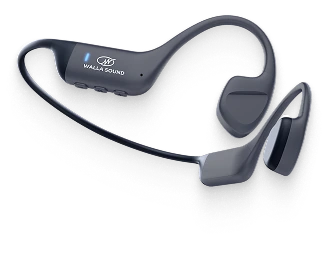
It had the feature I wanted most - 32GB of built-in MP3 storage, so I could load my playlists and run without carrying my phone. It was Bluetooth 6.0. IPX8 waterproof. And it weighed just 30 grams - lighter than most sunglasses.
All at a fraction of what the name-brand options charge.
What the Walla Sound Beat Actually Offers

 Open-Ear Bone Conduction Audio
 Built-In 32GB MP3 Storage
 Bluetooth 6.0 Connectivity
 IPX8 Waterproof Rating
 Ultra-Lightweight 30g Design
 5+ Hours Continuous Playtime
 Flexible Liquid Silicone Neckband
 Magnetic Charging Cable
 AI Voice Control (Siri/Google)
 Supports MP3, WAV, FLAC, APE
The Feature Most Competitors Leave Out

 32 gigabytes of built-in storage.
Here’s what surprised me during my research.
Most bone conduction headphones under $100 require your phone to play anything. You have to carry it, keep Bluetooth connected, and deal with the bulk while you move.
The Walla Sound Beat has 32 gigabytes of built-in storage. That’s enough for thousands of songs. You plug it into your computer, drag your files over, and go.
No phone. No armband. No Bluetooth dropout when you leave your phone in a locker at the gym.
This dual-mode setup - Bluetooth when you want it, standalone MP3 when you don’t - is something only headphones at $180 and above typically offer. Finding it in a sub-$100 pair was the reason I pulled the trigger.
What People Are Saying
“I run 5 days a week on roads. Switched from AirPods to these and the difference is night and day. I can hear cars, I can hear people - and my music still sounds great. The MP3 storage means I leave my phone at home now.”

“I swim laps three times a week. These are the first headphones that survived pool chlorine without dying. I load podcasts onto the storage and just go.”
“Bought these for cycling. Being able to hear traffic while listening to music isn’t just convenient - it’s a safety requirement. These weigh nothing and the silicone band stays put even at speed.”
“My wife got me these after I nearly got clipped by a truck while jogging with earbuds. Best gift she’s ever given me. Seriously.”
Who This Is For (And Who It’s Not For)
The Walla Sound Beat works well if you:
 Run, cycle, hike, or exercise outdoors and need to hear your surroundings
 Want to listen to music without carrying your phone
 Need sweat-proof and water-resistant headphones that last
- Prefer open-ear comfort over in-ear pressure
 Want bone conduction tech without spending $130 to $180
FAQs
The Bottom Line
Regular earbuds weren’t built for running on roads or cycling in traffic. They seal you off from the sounds that keep you safe.
Bone conduction solves that. You hear your music and your surroundings at the same time.
The Walla Sound Beat adds something most affordable options don’t - 32GB of built-in storage, so you can leave your phone behind entirely.
I’ve been running with these for two months now. No phone. No armband. No close calls.
Just me, my music, and the ability to hear everything around me.
That’s how it should have been all along.